Since the first state dinner in 1874, the United States has maintained a long-standing tradition of engaging in culinary diplomacy—a soft-power tool used to “increase bilateral ties by strengthening relationships through the use of food and dining experiences as a means to engage visiting dignitaries.” The recent eruption of multiple conflicts around the globe, however, reveals and confirms that culinary diplomacy cannot stand on its own. In the 21st century, no quantity of kebabs and challah could have prevented conflict between Israel, Iran, and now the United States.
How then should culinary diplomacy be thought of as a political tool? Harking back to the biblical tradition may provide guidance.
Among the many narratives of hospitality offered in the Bible, two in particular stand out. In 1 Samuel 25, a woman called Abigail prepares a feast of bread, wine, lamb, corn, and fig cake, among other things. Yet this is no ordinary display of hospitality. After Abigail’s husband, Nabal, disrespects David (the future king of Israel), the latter threatens to wage war upon the land in which his wrongdoer lives. Yet when David receives Abigail’s gift of food, he blesses her and credits her hospitality with precluding violent conflict.
Why then doesn’t culinary diplomacy work so beautifully, so easily, in the 21st century? For two reasons. First, some individuals may prioritize self-interest over mutual benefit. Second, the act of breaking bread holds less significance in the 21st century than it did in years past.
The breaking of bread as a symbolic act has a rich history going back millennia and is to be found in many cultures worldwide—from the Southern Europe to India, from the Near East to Morocco. Sharing a meal has been seen as an opportunity for more than just camaraderie, but also for mutual understanding and reconciliation.
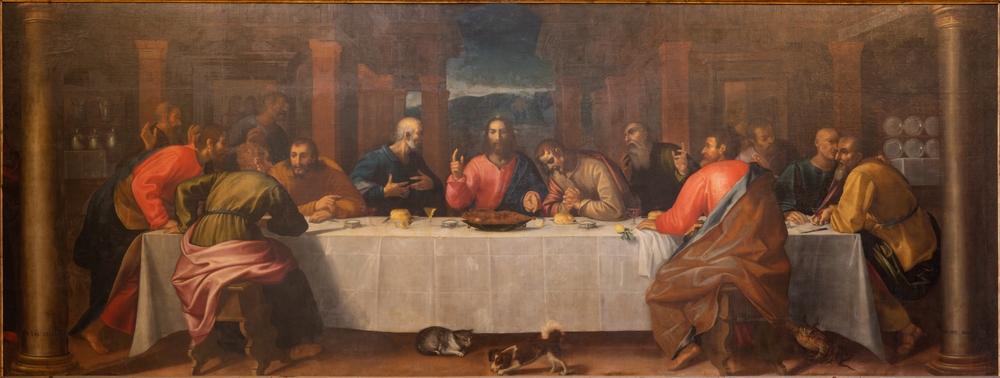
Even so, the elaborate account of the Last Supper found in the Gospel of Matthew best illustrates the limits of culinary diplomacy. In this telling narrative, Judas Iscariot dines in the presence of Jesus mere hours after arranging his capture. While sitting at the table, Jesus goes so far as to tell the disciples that one of them will soon betray him. Burdened by the weight of his transgression and the 30 pieces of silver for which he traded Jesus, Judas asks, “Master, is it I?” (Matt. 26:25 KJV). The Lord responds, “Thou hast said.” Unlike the story told in 1 Samuel 25, food does little to stop Judas from pursuing conflict.
Though the Last Supper was not intended to be a conciliatory event between Judas and Jesus, it reveals something deeper about the limits of culinary diplomacy. It demonstrates that such hospitality is not always transactional. In American political history, state dinners have been used not only to demonstrate hospitality but also to advance national interests. Over several courses, foreign dignitaries and domestic representatives discuss the affairs of their home countries as well as the future of their bilateral partnerships. The efficacy of state dinners in furthering political allyship depends upon the willingness of the present parties to operate in good faith. When Judas arrived at the table for the Last Supper, he already had every intention to betray Christ. Sharing a meal did not change that.
In The Prince, Niccolo Machiavelli praises the Romans for their strategic foresight and mercilessness in handling conflict. As Machiavelli explained, the Romans knew “war is not to be avoided, but is only put off to the advantage of others.” If one affirms this Machiavellian approach to conflict resolution, they stand to gain little from culinary diplomacy.
While some political leaders overemphasize the necessity of culinary diplomacy and prefer soft-power tools, others adopt a more Machiavellian understanding of interstate relations. In doing so, they fail to understand that early diplomatic efforts may work to strengthen relationships on a global scale. If, in 1 Samuel 25, Abigail had waited for David’s army to besiege her community before offering provisions, she would have failed to act at the time culinary diplomacy would have been most efficacious.
Although the aforementioned narrative reveals a one-to-one correlation between culinary diplomacy and conflict aversion, the Last Supper demonstrates that communal dining guarantees neither allyship nor loyalty. In the Gospel of Matthew, the story of the Last Supper is preceded by the Parable of the Great Banquet—one that speaks further to the biblical understanding of hospitality. In this parable, a wedding feast is being prepared. Tables laden with an array of dishes are arranged for a select few. The host, seeing the banquet being organized, sends a messenger to gather his guests. Every invitee declines, each providing a unique excuse for his absence. While Jesus uses the parable to urge his disciples to be ready for his ultimate return, and to be fruitful in spreading the gospel in the interim, it is also an invitation to gratitude and loyalty. At the Last Supper, Judas sits in the presence of Christ while simultaneously rejecting his warning, and invitation—much like the guests in the aforementioned parable. In doing so, Judas cheapens the hospitable act of communal dining. One of the great tragedies of the Last Supper is Judas’s failure to recognize the significance of the offered eucharistic meal.
Judas is not the only one to make such a mistake. The act of “breaking bread” simply holds less significance for us than it did for earlier generations. The removal of the dining table via the introduction of drive-in restaurants in the 1920s and TV dinners in the 1950s have contributed, in part, to the lessening of coordinated fellowship around food. Researchers have also observed a generational decline in the tradition of sharing family dinners over the last century. Mealtimes have, on the whole, become less and less sacred. This trend has carried over into the political arena, with American state dinners occurring at a less frequent rate today than at any point since 1874.
Going forward, the United States should prioritize both culinary diplomacy and additional means when engaging with foreign dignitaries. Relying on both soft and hard power would allow the nation to make use of all available political tools. While the Last Supper reveals that the sole act of sharing a meal does not guarantee reciprocal goodwill, the use of food in 1 Samuel 25 demonstrates that culinary diplomacy may be beneficial if employed at the appropriate time. While conflict between warring nations will likely not cease as a result of one state dinner, extending such hospitality in good faith before a conflict begins can provide an opportunity for political allyship.