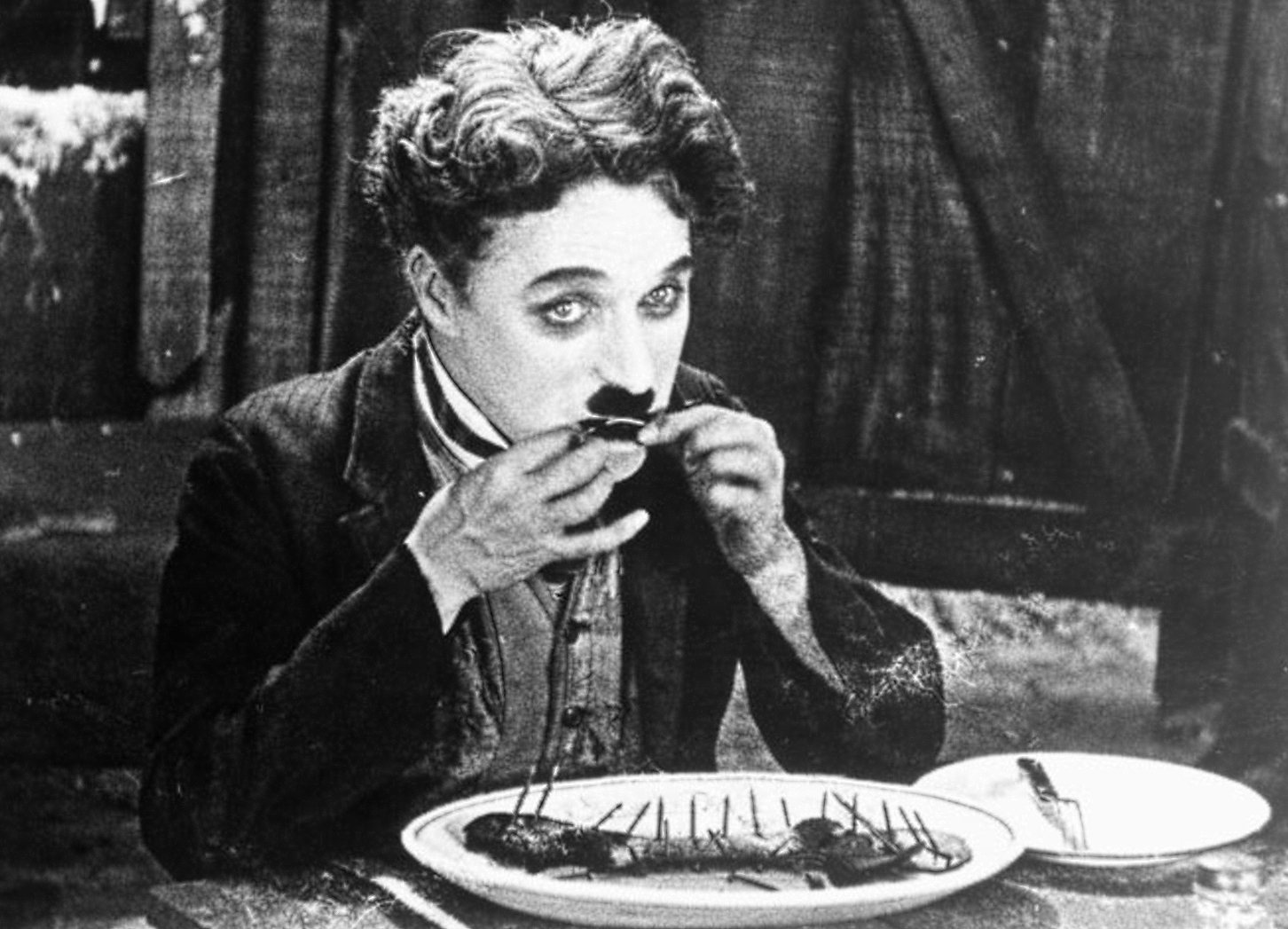
A hundred years ago, Charlie Chaplin brought out The Gold Rush, an incredibly famous and influential silent movie that has won the praise of countless artists since. Comedy on screen asserted its rights, as did artists. Accordingly, The Gold Rush is typical of Chaplin’s art, a mix of the high and the low, of the comedy found in the pursuit of happiness, and the warmest sentimentality! It’s also a New Year’s Eve movie, a comic fairy tale.
Chaplin not only wrote, produced, directed, and starred in the movie, which was one of his triumphs, both commercially and critically, but he later re-released it in 1942, with a score, his own narration, and a significantly shorter runtime. Re-edited, the movie satisfied Chaplin’s demand that sentiment be liberated from any detail of storytelling that might savor of the sordid or cynical.
Chaplin, as The Tramp, billed as The Lonesome Prospector, adventures in search of gold in the Klondike at the end of the 19th century. There is a scene for the human drama: Desperate and eager, men go in vast numbers to make their fortune or meet their end. The life-and-death stakes appeal to Chaplin, who’s always trying to show that, behind the ordinary life of middle class society, there are much stronger motives actuating the human heart than the prospect of “commodious living,” to recall a phrase of Thomas Hobbes. As the 20th century dawns, man is still an adventurer.
Caught in a storm, the Tramp makes for a flimsy cabin, where he finds himself trapped between Black Larsen, a wicked man, and Big Jim McKay, a rather nobler figure who saves him. The three face the prospect of death by storm if they venture out or starvation if they stay in, since the storm does not relent. So they draw lots. As luck would have it, Black Larsen draws the short straw and is sent out to find food.
This leaves our two protagonists to face the maddening effects of hunger in a comic manner. First, they boil a shoe to eat the leather; then Big Jim contemplates cannibalizing the Tramp; finally, they are attacked by a bear whom they end up eating. Human weakness and necessity make for remarkable comedy here but also call forth unsuspected resources, of manliness as well as imagination. In short, it’s not pity but patience that comedy calls for to bring out something of the national character—a certain mix of endurance and inventiveness that connects the modern American to the most ancient man who had to face an unfriendly world.
The two survive the storm but part ways—they are individualists, one sentimental, the other rugged. They might be considered natural allies, since they are complementary, but each feels so strongly the desire to pursue happiness that there is nothing to be said for the lessons learned fending off death together. If the first act is a kind of examination of the state of nature, the second act is an examination of society.
To that end, the Tramp ends up in an improvised city, a camp that may seem a mere mockery of civilized life, except that it reveals the downside of modernity, in which men are mostly strangers to each other. The Tramp, a figure of derision, quickly falls in love with a dancer, Georgia, whom he hopelessly invites to spend New Year’s Eve with him. She obviously looks down on him, more or less as the audience does, but not without fondness. It is the deluded way in which he attempts to carry on with dignity, although he is the plaything of a cruel fate, that makes the Tramp’s suffering so funny.
Another strange dinner makes for a climax for the second act of the comedy. The girl doesn’t show; the Tramp had prepared everything in his endearing and pathetic way. Instead of a dinner, he imagines a show—Chaplin’s famous bread-roll dance with the forks, an attempt to amuse the absent girl, whom he conjures by imagining her dance. That is the meaning of the scene—Chaplin would win her love by showing her that he understands her situation, that he can imitate it well enough to get it across to her with a certain comic delicacy. Chaplin redoes Edgar Degas’s famous ballerinas.
Then, as people begin to sing the traditional “Auld Lang Syne,” Big Jim reunites himself with the Tramp in heroic fashion—by abducting him. Jim has had to fight Black Larsen, who ambushed him, walloped him with a shovel, and left him with amnesia. Big Jim recovered himself, but not his memories, and thus realized he needs the Tramp if he is to remember the path to the cabin—which would lead him to his gold find.
The two end up in another storm and barely survive another comic series of events that tend to prove that man is nowhere safe in this troubled world, except that, by some kind of providence, the noble and the good-hearted do not come to perish. Moreover, they do find gold and end up wealthy, and so they return from Alaska to America, from the wilderness to civilization.
Just as he returns to ordinary life, the Tramp puts on his old clothes to indulge the press—everyone loves a rags-to-riches story. The press sells hope, which is, remarkably, often in demand. Thus, he runs into Georgia. Not knowing of his fortune, she tries to save him—they’re on a boat and she fears he has stowed away and will be discovered. Chaplin himself offers hope in a rather more delicate way than the press, by showing what would be required for love to flourish. After their Alaskan mishaps, the two find the opportunity to show their affection, the desire to protect each other, to tend to the wounds of loneliness. They find love.
That’s Chaplin, forever attempting to show that humanity counts more than the hustle and bustle of modern life, that a man doesn’t really know his heart when he contemplates the power and splendor he could acquire by wealth, but only when he can see his own troubles in the troubles of someone he loves. The beautiful and the artists, conscientious objectors in the commercial society, must face up to the human condition and find their place in that society, too. They suffer on our account and try to cheer us, to reconcile us to the uncertainty of our situation with comic grace. Have a Happy New Year!