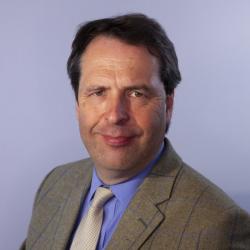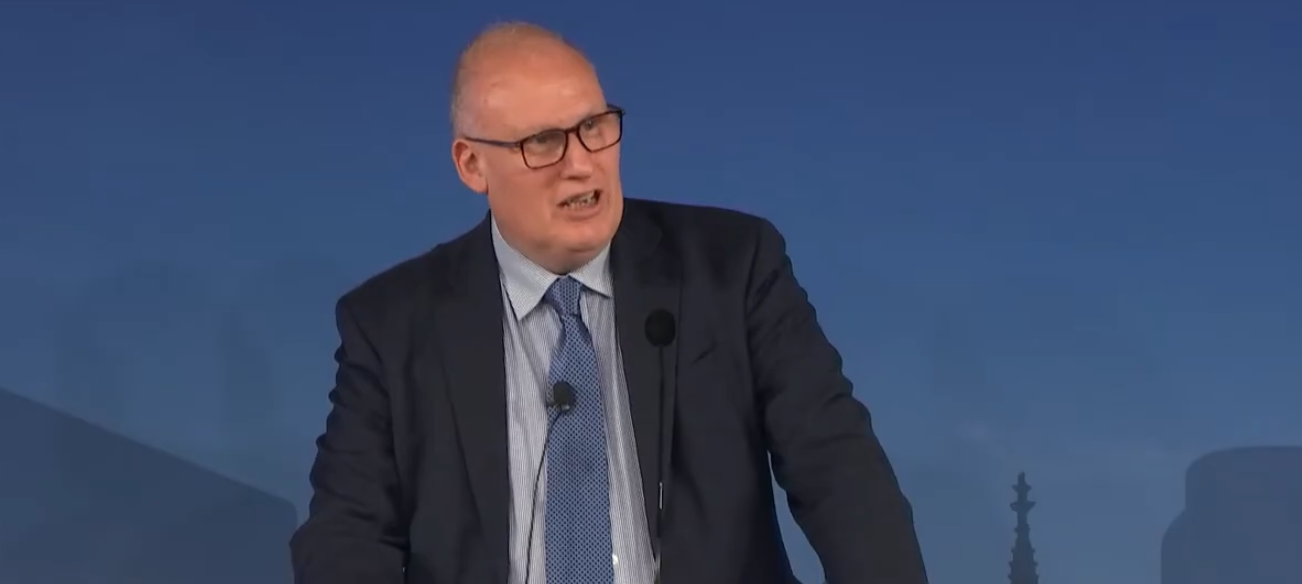
The Rev. Dr. Richard Turnbull, long-time friend of the Acton Institute, sadly died on November 26, not long after being diagnosed with terminal cancer. Many friends, colleagues, and collaborators joined a Whatsapp group to pray for Richard and his family in his final weeks, and the affection and admiration that so many people had for him was clearly expressed over those weeks. Richard and his family were deeply touched and supported by the heartfelt prayers of so many.
Richard participated in several Acton Institute events and inspired others, including staff members at the think tank he founded, to be involved, too. Richard had the perfect background for Acton, having graduated in economics and accounting and qualified as an accountant. He became a Christian at university. After time in professional life as an accountant, he was then ordained into Church of England ministry. He obtained a Ph.D. in theology from the University of Durham. He contributed greatly to the Church of England in various ways, including as principal of Wycliffe Hall, Oxford. He was also chairman of the Christian Institute, a religious think tank that has made a number of important contributions to the debate in the U.K. on life issues and sexuality.
When Richard moved on from Wycliffe, he founded, with Lord Griffiths of Fforestfach, the Centre for Enterprise, Markets and Ethics (CEME) and became its first director. The mission of the Centre is “to bridge the interface of theology, economics and business in promoting an enterprise economy built on solid ethical foundations.”
At this point in his life, this was the ideal calling for Richard. His ability to reason as a theologian and an economist was important for making the case for enterprise and for markets as well as for the importance of ethics in same. In particular, he was able to use his knowledge of scripture, as somebody from the evangelical Anglican tradition, to make a unique contribution here. Richard also drew on Catholic social thought and teaching and was particularly impressed by the publication “The Vocation of the Business Leader,” which was published jointly by the Dicastery for Promoting Integral Human Development of the Vatican and the John A. Ryan Institute at St. Thomas Minnesota.
Scriptural insights are often not as prominent in Catholic analyses of economic and social concerns, and so Richard made an important contribution to Catholic thinking, too. It was therefore with great joy that we welcomed him to St. Mary’s University (the U.K.’s biggest and oldest Catholic university) as a visiting professor in what was then our School of Business, Law and Society. At St. Mary’s, Richard guest lectured on the M.A. in Catholic Social Teaching—again providing insights from scripture that the students appreciated. St. Mary’s also organized joint events with CEME and a Christian fund-management firm, CCLA.
In my view, Richard’s most interesting contribution was in the field of Quaker capitalism. This might appear a niche area, certainly in the U.K., where Christianity-inspired businesses are less common than in the U.S. But this is an extraordinarily interesting and important phenomenon in the field of business ethics, which has implications for businesses today. There were only about 20,000 Quakers in England and Wales in the 19th century, but all of the following companies were founded by Quakers, and their management was explicitly based on Quaker principles: Cadbury; Rowntree’s; Fry’s; Huntley & Palmers; Jacobs; Lloyds; Barclays; Clarks; Friends Provident; Reckitt and Sons, as well as many others. These grew into some of Britain’s most important businesses; indeed, many of them became significant on a worldwide scale. It is especially sad that Richard died just as he was due to start work on a commission from Cambridge University Press that would have produced the definitive work on this topic. In fact, he had recently retired as director of CEME to work on this project.
Especially interesting was work commissioned by Richard for CEME that examined the different attitudes to business among bishops, clergy, and laity in the Anglican Church. It found that the clergy had a much more negative view of business and a more positive view of higher taxation to solve society’s problems than did the laity.
I particularly valued the contributions Richard made to projects in which I was involved. The Catholic Bishops’ Conference of England and Wales recently produced the document “Render unto Caesar,” in which Richard provided a chapter on “Taxation in Sacred Scripture.” Not yet published is a set of papers on ethics in investment and the relationship between investment and Catholic social teaching by the CCLA in which Richard also had a chapter focusing on scriptural insights.
As far as scholarly work is concerned, however, there was much more to Richard’s portfolio than his think tank work. He wrote a number of books, for example on Lord Shaftsbury and on the evangelical revival in 18th-century England.
On a personal level, Richard was always extremely supportive and an inspiration to many. He cooperated with a number of other organizations, never caring who got the credit. As Ronald Reagan is widely thought to have said, “There is no limit to what you can achieve if you don’t care who gets the credit.” It has always amused me that this was first written by a Jesuit priest, Fr. Strickland, but he never gets the credit for it! Whoever originated the saying, it could certainly have been applied to Richard Turnbull.
Richard’s death was a very sad moment for all who knew and worked with him. At this time, we send our condolences to Richard’s wife, Caroline, and his four children. I know they will appreciate the prayers of all associated with the Acton Institute. May he rest in peace.