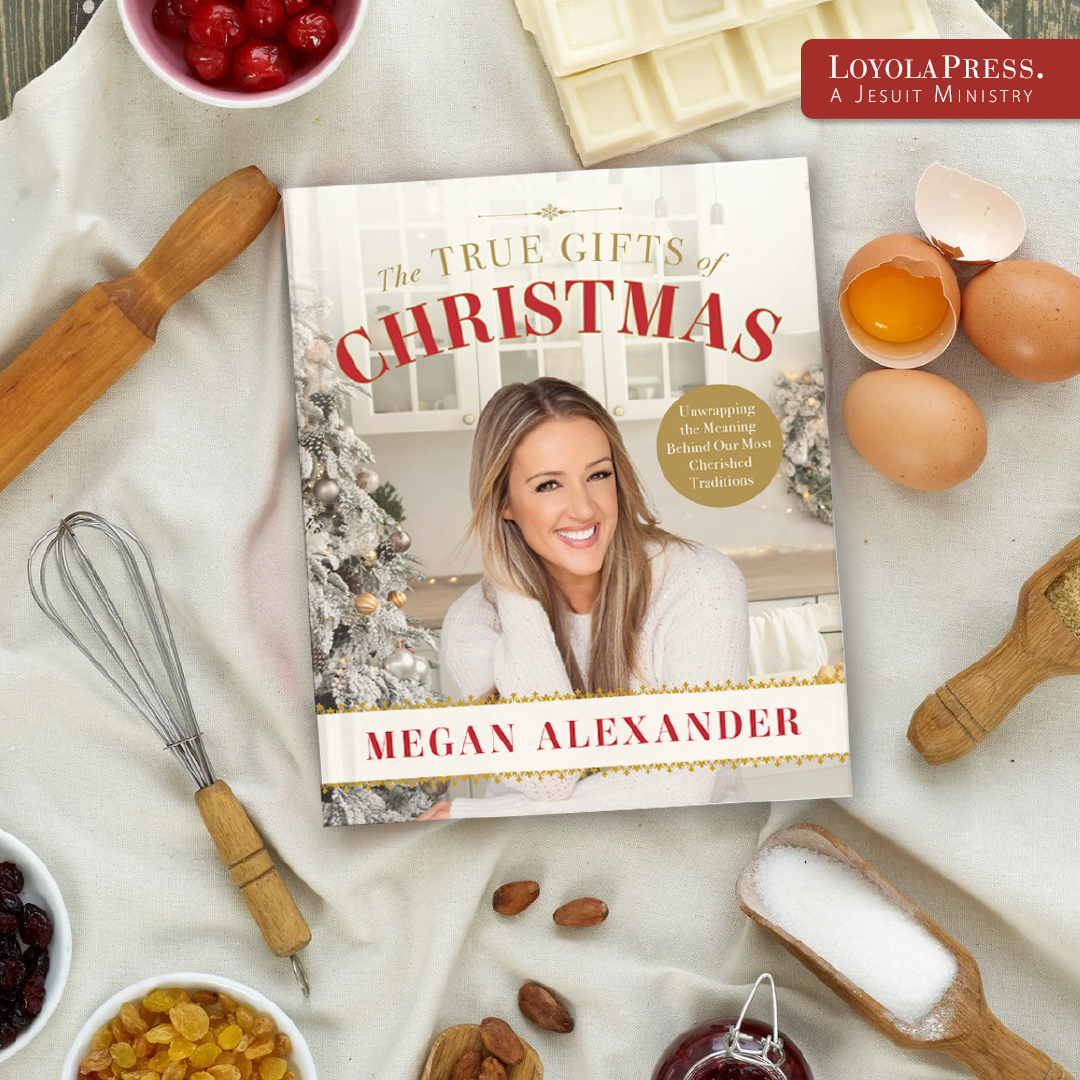
In her new book, The True Gifts of Christmas: Unwrapping the Meaning Behind Our Most Cherished Traditions, TV’s Megan Alexander shares the origin of her love for the Yuletide season and the meaning behind many of its most beloved traditions. Best known as a veteran correspondent on the long-running syndicated TV magazine Inside Edition, as well as her on-camera work on Thursday Night Football, Alexander is also an accomplished producer of faith- and family-friendly TV content, including three seasons of the reality show Small Town Christmas (this year airing on Fox Business Network) and a soon-to-debut holiday movie (more on that later). A sought-after speaker and author on topics involving faith and family, The True Gifts of Christmas is formatted like an Advent calendar, with each day revealing the backstory of a cherished seasonal custom.
JWK: What led you to write this book?
Megan Alexander: The secularization versus the spirituality of Christmas. I dread that question I’ll get from my kids—you know, is there really a Santa Claus?
Is there?
Yes, Santa Claus is based on a real man who grew up in what is now modern-day Turkey. He loved the Lord. He was a bishop. He lived a life of poverty. So many of our Christmas traditions come from him, including stockings and gift-giving.
After doing my research, I thought, “Omigosh! I’m not scared of that question anymore! I wonder if other families need help in terms of finding the Christian meanings behind our traditions.”
So I pitched the idea to Loyola Press. I said, “What if this book is kind of an Advent devotional—a deep dive into finding Jesus in all our seemingly secular Christmas traditions. It has just been a delight to put together. It’s my hope that people will be rejuvenated and empowered. Christmas traditions are very religious. You just have to brush off the dust a little.
So St. Nicholas is kind of a real-life hero of yours.
Oh, absolutely. He was an amazing man whose parents were wealthy and gave up the comforts of life to serve the Lord, to serve the Church, and really did some heroic things. Our tradition of stockings comes from a story of his being aware of a family in his neighborhood that was so poor that the daughters didn’t have enough money for a dowry to get married. There was a fear that they would be forced into a life of prostitution. They hung up their stockings at night to dry them. Legend has it that St. Nicholas dropped gold coins in the stockings. The next morning, the family woke up and found the gold. He saved them from a horrific life, and they were able to have enough money to pursue a better one.
He also was known for leaving presents all over town, especially for poor families. Talk about a model of servanthood and somebody that very much had Christ-like qualities. He was incredible.
Tell me about the significance of Advent and why you chose the season as a theme for your book.
I, like so many people, love Advent calendars. It’s fun to look forward to something every day leading up to Christmas. I think the anticipation of it is so powerful. Then I thought, you know, instead of the chocolate calendars and all the little things that we do, what about if we take advantage of each day to teach something about Christmas and the historical significance behind these traditions. I tried to make it bite-size for families. I have three kids myself. I realize they don’t have super-long attention spans. So we tried to give a little bit of everything to everyone.
I never before looked at Christmas as preparation for the new year, but in putting together this book, I really see it as empowering and encouraging us to finally show our faith during the holidays and equipping ourselves to go into the new year with the confidence. It’s my hope that people will use this book for that.
You have been a huge Christmas fan since you were a child, right?
Yes. I’ve always loved it. You know—the magic of The Nutcracker, going to church and singing “Silent Night,” just the sights and sounds of Christmas. It’s always been my favorite time of year. I love it so much.

You also love Christmas songs. Do you have a favorite?
Well, one of my all-time favorites is “O Holy Night.” It’s one of the most beautiful worship songs ever written. It was sung at my wedding.
Tell me the difference between getting gifts on Christmas and the gift of Christmas.
Oh, that’s so good! Well, I think if we approach the holiday as one gigantic gift, there are so many opportunities to connect with people, whether it’s throwing parties and really making them meaningful in terms of fellowship and community, looking for ways to brighten other people’s days, or just enjoying the holiday together. I think Christmas is one gigantic gift all month long. There’s so much more fulfillment that comes in approaching it that way. It takes the emphasis off the actual gifts that we give.
We hope in the book to encourage people that gift-giving doesn’t have to be expensive. It can be something you make. I think my grandparents’ generation was really good at that. Whether it was cinnamon rolls that run in my family or some type of a craft, just bringing it back to something meaningful and taking it away from needing to spend a lot of money. I hope that people approach the gift-giving differently. The book gives you some ideas for that.
And you’re a big fan of traditional Christmas cards, correct?
I love cards. I collect them and put them on our wall in a massive collage. We try to send ours out right on Thanksgiving weekend. I love seeing families and getting their little updates on what they’re doing. Especially in this world of digital everything, I just love going to the mailbox with my kids and getting those cards. It’s cool that in this world of tech the Christmas card has not gone out of style.
How do you feel about prepaid gift cards, such as those issued by many stores and financial institutions? They can be less time consuming, but some people view them as impersonal.
Listen, sometimes people need to do what they need to do—especially if you maybe have mobility issues. It comes down to the meaning, to your heart and your intention of blessing somebody else.
You already spoke about the origin of the Santa Claus story. Tell me about the origins of some other Christmas traditions that might surprise readers.
The candy cane was fun to learn about and research. Some people may know this, but I didn’t. A candy maker in Germany in the 1800s came up with the candy cane. He wanted to create something a little bit more about the real meaning of Christmas. So the candy cane is in the shape of a shepherd’s staff or shepherd’s hook. The red and the white stripes symbolize the blood Jesus bled for us and the gift of salvation washing us as “white as snow” and being forgiven of all our sins. To me that was really interesting. I never knew that. When we’re done with our candy cane, we can take a minute and have a little teachable moment with our kids.
There’s another fun one in the book: the legend of the poinsettia. You know, poinsettias are these beautiful red flowers that we see during the holidays. It’s known as the “flower of the night” in Mexico. I researched that there’s a legend that a small Mexican village had their little church service every year with a Nativity scene on Christmas Eve. In Hispanic culture, gift-giving is a big part of that. They bring gifts to church, whether they set them on the altar or bring them to each other.
This poor little girl named Pepita had nothing to bring on Christmas Eve. Her brother said, “Listen, I’m sure whatever you bring, the Christ Child will appreciate.” So she literally pulled some weeds on the walk to church and set them on the altar. Legend goes that as she set them at the altar, they turned into beautiful red poinsettias. Everyone in the village called it a miracle, and this little girl was just overcome by how Jesus had blessed her gift.
Again, it’s legend, but that one was really fun to learn about. And I believe that miracles are still possible. I believe that miracles of the Bible still can happen.
I believe that, too. Tell me about The Twelve Days of Christmas and what they symbolize.
My research of The Twelve Days of Christmas was really interesting because I had no idea that there is deep spiritual significance to this song. This is another legend, but they say that this song was created as a way to teach children about the Epiphany and about the teachings and sacraments of Christianity. They can trace it back to the fourth century.
For example, a “partridge in a pear tree” represents Jesus, the Son of God. Christ is presented as a mother partridge, a bird that will die to protect its young. “Two turtle doves” represents the Old and New Testaments. “Three French hens ” represents faith, hope, and love—1 Corinthians 13:13. “Four calling birds”—Matthew, Mark, Luke, and John, the four Gospels. And it continues on. Each line of the song has religious significance. So you’ll never sing the song the same way again.
And the song is about the length of time between Christmas and when the Magi arrived, right?
Correct, which in the Catholic Church is January 6.
You also have a section in the book about the debate between cocoa drinkers and eggnog drinkers and which is the traditional drink for Christmas Eve.
Yes. And even apple cider. Some people sneak in apple cider. Which is the ultimate Christmas drink? My dad leans toward eggnog. I would lean toward hot cocoa. It’s just kind of fun how those drinks came about. Do you have a favorite?
Yes. Eggnog, I would say.
(laughs) It is sooo good. There is religious significance, too, like the oranges in eggnog can symbolize gold brought by the first king to Baby Jesus. The nutmeg represents frankincense gifted to Jesus by the second king. And then cinnamon sticks represent the myrrh that was brought by the third king. So it’s one more example of how even our drinks have some spiritual significance.
Besides the book and Inside Edition, what else are you up to?
I produced and acted in a Christmas movie. It’s called The Best Thing About Christmas. It’s a musical. We filmed it in Knoxville in April and it got picked up by UPtv. It will stream on December 19 and air on the cable channel December 20. So we’re thrilled about that. It was quite the project to put on and produce. It’s family-friendly. You know, that’s my heart—wonderful content you can watch with your kids.
And what are you doing with your family this Christmas?
Just trying to be there for my husband and my kids. I’m grateful that they support me and my projects, but number one—I love being a wife and mother. I just want to support my husband and my kids in their endeavors.
Anything else you’d like to say as we wrap up?
I’m at a point in my life where I really want to produce meaningful work. I want to try and make a difference in the world. I’m just trying to be part of the solution and do what I can to put meaningful positive content out there into the world. I’m so grateful to Loyola Press for believing in this book because it really was a pleasure to put together. I hope it blesses people.
(This interview was edited for clarity and length.)