What is man that You are mindful of him,
And the son of man that You visit him?
For You have made him a little lower than the angels,
And You have crowned him with glory and honor.
You have made him to have dominion over the works of Your hands;
You have put all things under his feet,
All sheep and oxen—
Even the beasts of the field,
The birds of the air,
And the fish of the sea
That pass through the paths of the seas.
—Psalm 8
The Psalmist articulated for us two long-held convictions about what human beings are and what they do: They are made in the image of God, the crowning glory of creation, and they have dominion over all creatures. Such dominion results from their distinctive status: God rules over all creation, and human beings, His greatest achievement, are deputized to care for and cultivate it.
The Genesis account treats development in terms of the hierarchy of Being, God creating from the lesser to the greater, but after creation is completed and God rests, the created world seems static, at least until sin makes its appearance. Historical dynamism, throughout the scriptural narrative, results from the dialectic of fall and redemption, leading to a final triumph over evil.
This story had difficultly surviving the challenges presented by Darwinian evolutionary theory, which stressed the continuity rather than the discontinuity among the species. Human beings no longer seemed like a crowning achievement, and historical dynamism shifted to the biological, a claim that also altered our whole understanding of temporal horizons. One species can’t become another overnight. Thinking of humans as created in the image of God seemed illegitimate arrogance. The infamous Scopes Monkey Trial dramatically brought the incommensurability of these explanations to public attention.
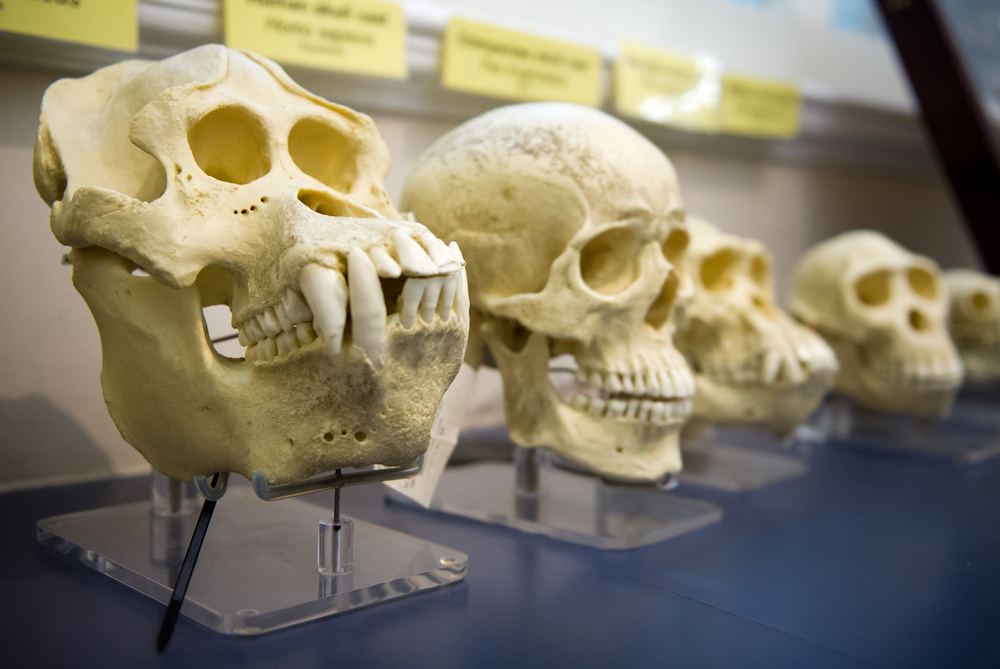
The story became more complicated in the latter half of the 20th century with the creation of “primatology” as a field of study, popularized in the works of Jane Goodall and Dian Fossey and movies such as Gorillas in the Mist and Planet of the Apes. The fundamental assumption of primatologists is that human beings can best be understood by comparing them with their “closest relatives”—namely, primates. This assumption begs two important questions: that humans are primates and that understanding one species requires comparison to another.
Jonathan Leaf in his new book, The Primate Myth: Why the Latest Science Leads Us to a New Theory of Human Nature, tackles the first question with an engaging thoroughness but largely ignores that second, which is too bad, because a more thorough engagement with the second assumption offers an opportunity to try to reconcile what seem to be incommensurate narratives. I’ll return to this point.
Still, it’s a remarkable book. Ambitious in scope, highly learned, and engagingly written, Leaf’s work accomplishes two important goals: It gives a real-life and real-time example of how scientific revolutions occur, and it (definitively) changes our understanding of exactly who our closest relatives are and what that relationship tells us about who we are.
We may be well removed from Aristotle’s explanations of the structure of the universe and the nature of motion, but we have never improved on his understanding of the structure of scientific knowing, part of which involves the problem of classification. One of the most important questions with regard to classification is why we do it in the first place, and then secondly what criteria we use in the process.
We classify because it’s a way of ordering the otherwise confusing array of material that constitutes the world. Our capacity for abstraction (a uniquely human trait?) allows us to identify features and generalize the results. Leaf argues that the work of primatologists has confused us about what human beings are and, as a result, human behavior. Classification always relates to these matters as we wonder how we know what kind of a thing a thing is. According to Aristotle, we get at the question in various ways, one of which is to identify common features while discrediting nonessential differences. Relatedly, we look at (1) those elements without which it could not be that thing and (2) elements that are not features of anything else. Classification moves from specificity to generalities, but in that process it must identify the points of exclusion. An important third way of knowing a thing is to look at its origin: Human beings are produced by other human beings, and this question of origins gets quite muddy in the post-Darwinian world, especially if comparable DNA is taken as evidence of common ancestry.
Human beings obviously share certain traits with primates, such as being living creatures and part of the animal kingdom, possessing vertebrae, and so forth. But primatologists took certain physical similarities to mean that human beings could be thought of primarily as primates, and Leaf strongly objects to this. “The primate myth,” he writes, is “the idea that we can learn who we are by studying chimps and gorillas and that our underlying patterns of behavior are the same.” If our understanding of human behavior derives from our assumption that we’re like primates, and we’re not, then we might have to reevaluate what we think human beings are.
Why not consider human beings primates? Leaf facetiously gives a pretty comprehensive list:
Humans are greatly akin to chimps. Indeed, although humans lack prehensile feet, and we are hairless, speaking, domesticated, pair-bonding, highly cooperative, mesocarnivorous bipeds who prefer to live on open plains, often far from the tropics, we are more like chimps than chimps are like gorillas. This is said to be so even though chimps and gorillas are both untamed, equatorial, forest-dwelling, herbivorous, tree-climbing knuckle-walkers who lack skills of speech and cooperativeness.
Getting past the assumed physical similarities, Leaf proceeds to explore the vast range of physiological differences between the ape family and humans, especially the differences in brain structure and hormonal makeup. This part of the book is remarkably detailed and, given that I’m not a scientist of that sort, I can’t evaluate the accuracy of his claims, although I found them compelling and the bibliography indicates extensive research. The net effect was convincing, especially as the discrediting of the primate myth leads to an analysis of humans that “better aligns with evolutionary theory—and the evidence all around us.”
What evidence? The more things change, the more they stay the same, and Leaf’s analysis of what we are and how we behave largely mimics that of Aristotle. Human beings, unlike primates, are inherently sociable creatures and, unlike primates, animals with language. Our sociability and language skills make us capable of domestication, of cooperation, and of empathy—characteristics completely absent in primates. They can be found, however, in other species. “Our anatomical likeness to primates conceals a series of fundamental dissimilarities. If we are to think of other animals as sisters and brothers, we would do better to look to the creatures with trunks and flippers.” And, we might add, dogs, like us a domesticated animal, whose capacity for learning language and signs is at least five times greater than that of even the smartest primate.
Primates are inherently dangerous creatures. Chimpanzees have to be tightly controlled if one is to work with them. They often kill their young and one another. They display no capacity for remorse, guilt, or shame. “There is a reason,” Leaf writes, “that there are lion tamers and dolphin, seal, and dog trainers, but no chimp tamers.” Our brains are constructed much more like those of dolphins and dogs than they are of primates, as is our hormonal structure. Humans, Leaf argues, are also herd or pack animals.
Understanding ourselves as herd animals has a wide range of implications. Because we tend to hunt for our food, we also tend to take on tasks that require patience and endurance; we tend toward conformity, including being subject to fads and fashions; we tend to find meaning, purpose, and identity within the group; we are more inclined to be altruistic and to take care of other members’ young (humans are one of only two species that have wet nurses); and we see sociability as the path to safety.
Our sociability and language skills also explain the dark side of human nature, and Leaf’s detours into those make for thought-provoking reading. Primates don’t commit suicide, but humans do, as do whales and dolphins. Primates don’t go to war, because they can’t create the levels of social solidarity, organization, and purpose necessary. Dolphins are the only other species where the females go through menopause, which Leaf speculates relates to helping their own progeny raise their young. Primates don’t grieve the way humans do. Leaf leverages off the distinction from primates to explain not only the above but a wide range of human issues.
The mistaken belief that we are not a herd animal also causes us to underestimate the risks of panic selling and buying in financial markets, and it leads us to absurd notions about marriage, fidelity, and the importance of stable social bonds. Altogether, it serves as a partial explanation for the failure of our elites to think substantively about the risks, problems, and issues that face us.
I’m generally skeptical of the claims of evolutionary psychology since they are speculative. The currency of evolutionary psychology results from its offering a comprehensive explanatory structure that seems plausible. So long as one accepts the premises and puts aside the lack of evidence, it’s a reasonably compelling way of describing human behavior. But it can also lead one to suspect conclusions, such as Leaf’s remarkable claim that giving women the vote is a sure path to ending war. Permit me to doubt.
Still, Leaf takes on a variety of topics one would not expect in a book of this type, and his comparisons across species both accomplish his task of debunking the primate myth and offer clues about how humans behave. As I said, it is in many ways a restatement of what Aristotle observed 2,500 years ago: Human beings are social animals who possess language and reason. Leaf also reflects on the dark side of such sociability that, interestingly enough, makes us look and act more like primates the darker it gets.
Which returns me to the question of whether understanding what and who we are requires comparison with another species, and if it does, does that requirement somehow diminish humans in the chain of being? Aristotle observed that we are more than beasts but less than gods, yet we have the capacity to debase or ennoble ourselves, and this capacity distinguishes us from all other creatures. Leaf does an admirable job describing similarities among species, but those comparisons can often obscure dissimilarities, their significance, and how we account for them. Such obscuring can blind us to what makes us just a little lower than the angels.
Leaf captures the new science of brain-imaging at its incipient stage, and undoubtedly it yields insights into human behavior. While shame, regret, and guilt may all be explained in part by realizing ourselves as herd animals, neither that identification nor all the brain images in the world get us any closer to understanding the mystery of consciousness itself. If dolphins, dogs, and elephants possess anything like conscious awareness and self-reflection, then they could be something other than what they are. Their behavior may not be, as often thought, pure instinct, but neither do they seem to be troubled by the fact of their own existence nor aware of their Heideggerian “Being-toward-death.” They certainly don’t study us the way we study them, nor do they seem on a perpetual quest to understand what they are and why they behave the way they do.
Leaf’s book gets us away from some animals but nearer to others, and nearer to others but no nearer to God, and because no nearer to God, perhaps no nearer to our true or best selves. No doubt a scientist would see this as a dogmatic claim, and perhaps it is, but no less dogmatic than the claim that species comparison and biochemical breakdowns are sufficient to self-understanding. But simply by writing a book comparing us to other species, Leaf demonstrates part of our dominion over them.