
We’ve all read about ideologues who had a centralized plan to save the world. Well add one more to the list. Trending right now is a man named Rutger Bregman. He is passionate, eloquent, and articulate—and he seeks to rapidly transform our country (and, indeed, the entire world) into a socialist utopia. In his latest book, Moral Ambition: Stop Wasting Your Talent and Start Making a Difference, Bregman envisions a world transformed through bold, centralized action—primarily by way of increased taxation, new legislation, and large charitable projects. Through top-down, centrally planned policy directives, he would tackle poverty, inequality, climate change, and a catalogue of other “pressing issues.” However, his sweeping vision lacks vital principles celebrated by such thinkers as Alexis de Tocqueville, Abraham Kuyper, and Robert Nisbet. Their insights into civil society, subsidiarity, entrepreneurship, and vocation provide a more rooted path to human flourishing.
Readers, beware! Purchasing Moral Ambition at its current Amazon price of $22.41 isn’t just buying a book—it’s a direct donation to Bregman’s organization, which actively implements his vision. Bregman funnels every royalty dollar into this new venture, The School for Moral Ambition. The school’s mission is to prepare, mentor, and equip young activists to tackle the world’s most pressing challenges—from anti‑tobacco legislation to the protein transition. If you’ve never heard of the protein transition, it’s the shift from resource‑intensive animal meats to plant‑based and lab‑grown proteins. Now you know.
Bregman casts himself as a savior guiding bright graduates out of what he calls “the Bermuda Triangle of Talent,” formed of consulting, finance, and corporate law firms, which, he warns, swallow top talent whole. His school promises to rescue you from that “sink” and redirect your future into causes he deems truly meaningful—like advancing the protein transition.
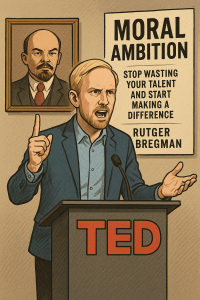 One key feature of Bregman’s program is heavy taxation of the rich and large‑scale redistribution. Instead of calling himself a socialist, he prefers to be thought of as a “modern‑day Robin Hood.” But Robin Hood confined his exploits to Sherwood Forest in Nottinghamshire; by contrast, Bregman seeks to redistribute across entire countries and continents. At that scale, Rutger Bregman is no local Robin Hood but a full‑throated collectivist whose economic strategy was captured perfectly at the World Economic Forum in Davos, where he famously declared, “Taxes, taxes, taxes! Everything else is bulls–t!”
Yet beneath this rhetoric lies an impoverished understanding of how true prosperity and human dignity are nurtured. Bregman holds an overly simplified view of society, as if people can be sorted into three neat categories: ordinary individuals trapped in meaningless roles, the idle rich, and morally ambitious heroes (whom he celebrates as a rare species!). He openly disparages large swathes of society, asserting that “numerous attorneys, consultants, marketeers, programmers, managers, accountants, and bankers are stuck in well-paid but relatively useless or even harmful jobs.”
This sentiment starkly contrasts with Michael Pakaluk’s recent book, Be Good Bankers, which offers a deeply humanizing and redemptive vision. For Pakaluk, businesspeople and financiers can be stewards of both material and spiritual goods—participants in a vocation that, when rightly ordered, contributes to the flourishing of families, communities, and even souls. Where Bregman sees futility—institutional traps that require top-down moral correction—Pakaluk sees profound moral opportunity. He calls on financiers to reclaim their dignity, not by abandoning their field, but by living virtuously within it. In doing so, Be Good Bankers rejects the idea that people can be only villains or wasteful sloths. Unlike Bregman, Pakaluk insists that even bankers can—and must—be moral agents.
Similarly, Bregman’s disdain for commercial society reflects his narrow and distorted view of how wealth is created. He persistently portrays the wealthy as morally compromised individuals, becoming affluent primarily through industries he deems harmful. To Bregman, the rich “dodge legislation and avoid taxes,” achieving prosperity by “damaging society.” This perspective sharply contrasts with the meticulous research of Princeton professor Owen Zidar. His forthcoming book, Stealthy Wealthy, emphasizes that many millionaires aren’t glamorous financiers or celebrities but often medium‑size business owners and tradesmen who quietly build value through essential, community‑based enterprises like HVAC services, dental practices, car dealerships, and local manufacturing. Thomas Stanley and William Danko’s classic The Millionaire Next Door highlights the same phenomenon. Unlike Bregman’s caricature, the majority of the rich live modestly, reinvest profits locally, and seldom answer surveys or appear in media—hence Zidar’s apt term: “stealthy wealthy.”
 Having dismissed commercial society, Bregman pins his hopes on nonprofits to transform society “the Bregman way.” However, his preferred method of funding charity is impractical and unsustainable. He devotes pages to lauding Rob Mather’s “World Swim Against Malaria,” celebrating a kind of “martyrdom” fundraising in which people run, walk, swim, or persevere through some feat of physical strength in order to buy mosquito nets. Practitioner fundraisers tell me this stunt‑driven approach never secures continuous support: Participants swim or run once, never form a lasting attachment to the mission, and quickly lose enthusiasm. Swimming against malaria may raise awareness, but it doesn’t provide the long‑term funding needed to eliminate malaria.
Bregman makes a classic nonprofit mistake by measuring World Swim Against Malaria’s success in outputs—“$700 million raised, 300 million nets distributed”—rather than outcomes. How many lives the project actually saved is never talked about. In reality, global malaria deaths have almost halved since 2000—dropping from about 985,000 in 2000 to around 550,000 in 2024. So, hundreds of thousands of people who used to die from malaria now survive every year. Should all of this progress be attributed entirely to the World Swim Against Malaria campaign and the mosquito nets they provided? Absolutely not! As I explored in my Daily Economy article, “Plastic’s Quiet Role in Defeating Poverty,” fighting malaria is far more complex than just shipping mosquito nets: It’s a multifaceted battle requiring economic growth, technological advances, and market participation. We don’t just need more mosquito nets—syringes, vaccine vials, water‑storage tanks, and food‑preservation technologies are all vital to sustain both the health and livelihoods of people living in regions susceptible to malaria. These solutions depend on fossil fuels and industrial capacity—resources Bregman dismisses as “useless,” undermining the very foundations of a lasting victory over malaria.
In contrast to the massive yet narrowly focused World Swim Against Malaria campaign, small-scale, locally rooted initiatives deliver both health impact and community resilience. For example, in Malawi, Population Services International partnered with trusted local nurses—who knew their patients—to sell nets at affordable prices, teach proper use, and keep nets out of the black market, where they often become fishing nets or wedding veils. This intimate model, grounded in personal relationships, fosters trust, ensures correct usage, and keeps money circulating in the community—everything Bregman’s cold, centralized blueprint overlooks.
Moreover, Bregman’s abstraction of compassion as distant, large-scale action misses its true meaning: com‑passio—“suffering with”—which demands local, person‑to‑person care. Genuine transformation, drawing on insights from thinkers as diverse as Martin Luther and Alexis de Tocqueville, emerges when communities solve problems through close relationships and shared vocation, not through impersonal statistics or remote charity campaigns.
Although Rutger Bregman and Abraham Kuyper share Dutch roots, their worldviews diverge sharply. Bregman explicitly dismisses small, local actions as insufficiently ambitious and shows little appreciation for the rich tradition of sphere sovereignty developed by Kuyper. Kuyper taught that each sphere of life—family, church, business, government—possesses its own distinct dignity, role, and responsibility. A healthy society arises not through domination by a single, all-powerful authority but through balanced cooperation among these spheres. Without such interplay, civil society loses its vitality. Bregman fails to see this, which is a serious oversight.
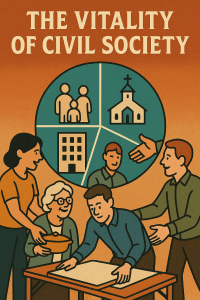 A vibrant civil society does more than exist—it provides roles to play. Tim Carney, author of Alienated America and Family Unfriendly, calls civil society “the things we belong to, bigger than the family and smaller than the entire United States,” things that are voluntary yet “a little sticky” and situated “between the individual and the state.” It “gives us a role to play,” he says, recalling a church potluck where a friend asked, “Tim, can you stick around afterwards and fold up the tables?”—and suddenly he became “Tim the table-folder.” In that moment, he recalls, a mere spectator turned into a participant! In a world marked by rising anxiety, loneliness, and depression, these small roles—local, embodied sources of meaning—are not trivial; they are lifelines. Yet Bregman doubles down, pushing already disoriented and demoralized people deeper into despair by labeling their contributions as meaningless, wasteful, and part of the “bulls–t jobs” economy. His rhetoric, though passionate, risks stripping people of the very dignity and purpose our anxious generation so desperately needs to heal.
Moreover, Bregman’s moral appeal is suspiciously urgent. Instead of patient persuasion or thoughtful debate, he pushes blunt, immediate fixes with alarmist language. Bregman employs rhetoric that signals a ticking clock: “We have to get off fossil fuels and kick the habit of eating animals—now, in a crazy short timespan,” delivered with the same pressure tactics as a scam call that insists you provide a credit card number—or else! We’ve all received such calls and emails demanding instant compliance, and Bregman’s pressing plea is a textbook red flag.
To conclude, Bregman’s goals—ending poverty, reducing inequality, and addressing environmental concerns—are noble and will resonate with the conscientious. Yet his narrow, centralized approach oversimplifies reality. In doing so, Bregman doesn’t merely undervalue but misses entirely the fundamental role that virtue, civil society, entrepreneurship, and local subsidiarity play in achieving sustainable human flourishing. In the process, he dismisses the rich heritage and wisdom of civil society participation, the union of charity and entrepreneurship, and the pursuit of individual vocation infused with moral purpose.
Rutger Bregman invites readers to exercise moral ambition, but a more grounded invitation is to practice moral imagination. Moral Imagination is also the title of a podcast by Michael Matheson Miller. He defines moral imagination as the capacity to see people in their full moral complexity, to perceive the interdependence that binds communities and to recover the webs of relationships, traditions, and ordinary roles that offer dignity and meaning, thereby resisting reductionist schemes. Crucially, moral imagination is cultivated not through statutes and regulations but through the stories, parables, and even unwritten folklore that quietly educate us in how to live. These narratives shape character, form virtue, and guide action in ways no legislation can.
Bregman, by contrast, sees meaningful change almost exclusively through the passage of laws, the expansion of regulations, and the enforcement of policy—largely ignoring the quiet moral formation that culture and stories provide. Proper moral imagination requires embracing interdependence and respecting the unique contributions of every individual, from the entrepreneur quietly funding community growth to the janitor cleaning school halls so children can learn safely. Through his podcast, Miller offers a practical, bottom-up antidote to Bregman’s ideological, top-down strategy—one that urges ambition tempered with humility. That imaginative, story-rooted approach provides a more durable and realistic blueprint for societal transformation than Bregman’s superficially appealing yet misleading revolutionary call.