The House of Lords, with its resplendent red leather benches, a throne for the monarch at the state opening of Parliament, a rather uncomfortable-looking cushion seat (known as “the Woolsack”) from which the Speaker of the House presides over proceedings, and a host of history, architecture, and traditions, is a unique feature of the British constitution. Like the U.S. Senate, it is a legislative chamber; unlike the Senate, it is not elected. This extraordinary feature in a modern democracy has, however, one significant benefit: The members of the House of Lords represent both experienced politicians and others who bring expertise and weight to national debate.
The Terminally Ill Adults (End of Life) Bill arrived in the Lords for debate on Friday, September 12. There will not be a vote at this stage, but there will be a final vote on whether to accept the bill in a few months’ time. This allows a moral debate to take place without the immediate pressure from either constituents or parties. It will be important to observe which voices are raised pro or con, the prominent players who contribute to national life, and the caliber of the arguments deployed.
The outcome of the bill is not clear. It passed its first vote in the House of Commons by 330–275, but by the time of the final vote in the lower house, by only 314–291, a majority of merely 23 votes. There remains much to fight for.
Former prime ministers usually have the option of appointment to the upper house upon leaving the House of Commons. Baroness May, the Rt. Hon. Theresa May, prime minister from 2016 to 2019, is a respected voice, and it was a coup for opponents of the bill to recruit her as their lead spokesperson in the Lords. A calm and moderate voice, May did not mince her words. She drew attention to matters of principle (which we will consider in more detail shortly): inadequate safeguards against coercion, the impact on those with disabilities and mental health conditions leading to a devaluation of some lives, and the inevitable pressure for the scope of the bill to expand. The bill, said Mrs. May, is not an assisted dying bill but an assisted suicide bill: “As a society, we believe suicide to be wrong … but this Bill effectively says suicide is OK.” May offered a friend’s nickname for the proposed legislation: the “‘license to kill’ Bill.”
Arguments about process, poor drafting, and inadequate time for discussion are essentially peripheral. What Theresa May did was articulate the central moral arguments of the debate, and ultimately we win the moral case by persuading decision-makers and wider opinion-formers of the power, depth, and principled nature of these key arguments. Pointing out that it is merely a badly drafted bill may help you win a battle but it will not win the war.
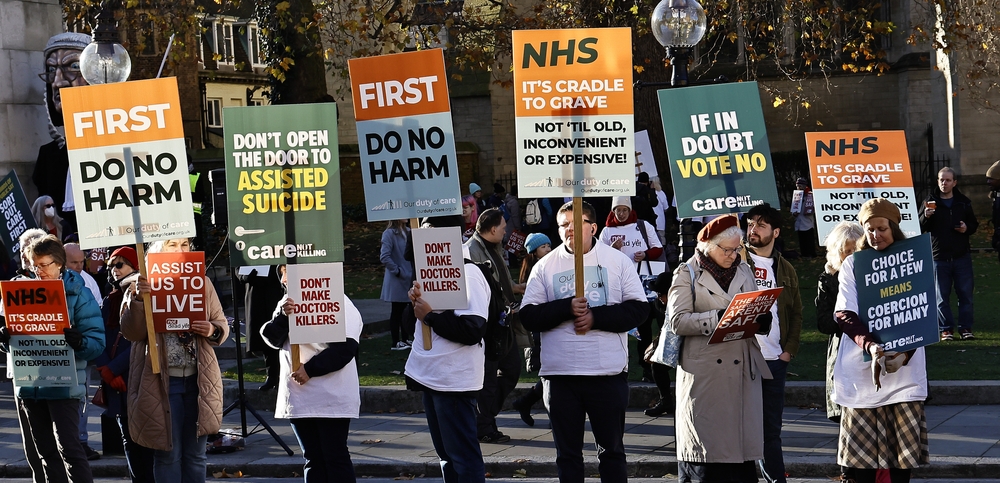
The first principle that opponents of the bill have deployed is to emphasize the inherent danger of coercion, such that the proponents’ main argument of individual autonomy in decisions about the end of life is turned completely on its head. It should be noted that the Church of England’s bishops (26 of whom hold seats in the House of Lords) are remarkably united on this topic. For example, the Bishop of London, the Rt. Revd. Sarah Mullaly, expressed in the first day of the two-day debate her concern “for those who will face internal and subtle pressure to end their lives in the absence of adequate palliative and social care, or to avoid being a burden to their families. I understand the fear of many that they may be offered free assisted death before they are offered the care and equipment that they may live.”
She went on to describe the choice to die as illusory. One person’s choice to live can become another’s duty to die. It is this concern about coercion and the lack of safeguards in the bill that has caused three professional bodies—the Royal College of Psychiatrists, the Royal College of Physicians, and the Royal College of Pathologists—to oppose the bill, at least in its current form. The colleges have warned that there are simply not enough professionals to staff the panels proposed in the bill as a safeguard. Consequently, the bill does not, in fact, protect the vulnerable from coercion.
This then takes us to the second point of principle: the bill’s view of human life and dignity, which is at fundamental odds with any Christian understanding of same. In the cauldron of debate, some proponents of assisted dying have criticized Christians for bringing their religious faith to the issue, which is rather strange, as it is not as if the bill’s supporters don’t deploy their Enlightenment rationalism when making their arguments. This may have led to a slight reluctance on the part of opponents to articulate such a fundamental point of Christian faith, but it is, after all, applicable to all human beings as bearers of God’s image, not merely committed Christians.
This point was beautifully summarized in the debate by the Bishop of Southwark, the Rt. Revd. Christopher Chessun: “The Christian conviction retains the belief that life is of intrinsic value at all stages. …There is never a point at which it may be said it is not worth it.” We should not be afraid of expressing, voicing, and advocating a truth at the heart of our Faith in the service of the whole of humanity.
The third point of principle that came to the fore in the debate was “the slippery slope.” The experience in many other jurisdictions of the introduction of assisted dying has been, almost universally, for the safeguards to be relaxed and the scope expanded. Hence there is significant danger that a bill that passes even narrowly, even on a restricted basis, once in the statute book, will inevitably become increasingly expansive. Canada, the Netherlands, Belgium, and some U.S. states such as Oregon and Washington are perhaps the most extreme examples.
Canada introduced assisted suicide in 2016. Initially, death had to be reasonably foreseeable. That safeguard has already been dropped: Canada’s Parliament has voted to extend the provision to the mentally unwell—as a sole valid criterion for requesting assisted dying. Rather than care for the most vulnerable members of society, we offer them a lethal cocktail of drugs. In Canada this form of euthanasia is called “medically assisted dying,” a word salad that covers up a much more gruesome reality. One Nova Scotia cancer patient was offered assisted dying as an option instead of a mastectomy—which the patient herself described as completely inappropriate. In the Netherlands and in Belgium, children under the age of 18 are permitted to access the assisted dying provisions. In Canada, the extension to children was recommended by a Parliamentary committee but is currently held in abeyance. In Oregon, where there is at least some level of reporting, there have been frequent complications over the use of the lethal drugs prescribed. In 1997, the first year of assisted dying in Oregon, 13% of applicants cited “being a burden on their caregivers and loved ones” as a reason for seeking assisted dying; in 2017, this rose to 52%.
We cannot overlook this alarming and precarious future, filled with enormous danger to the very moral order of the world in which we live. The concept of individual autonomy must not be allowed to reduce the gravest issues of life and death to the level of just one more pragmatic choice.
The final vote in the House of Lords on The Terminally Ill Adults (End of Life) Bill is still some time away. There is always an understandable reluctance to try to block a bill that has passed in the Commons. However, this is not a normal bill. It is not a government bill and was in no party manifesto; it is an initiative of an individual Member of Parliament. There will be a vote and, indeed, it may be quite close.
The experience of the House of Lords debate is a reminder of the power of moral argument. We must not shy away from setting out, articulating, and advocating for a moral world order. We cannot allow the pragmatic to replace the principled; we must not fear setting forth a view of life in which human beings are not simply rational automatons or robots, but part of an ordered world, one shaped by natural moral law and, many of us would want to say, by a divine one.
Please pray that this bill fails—and for the right reasons.