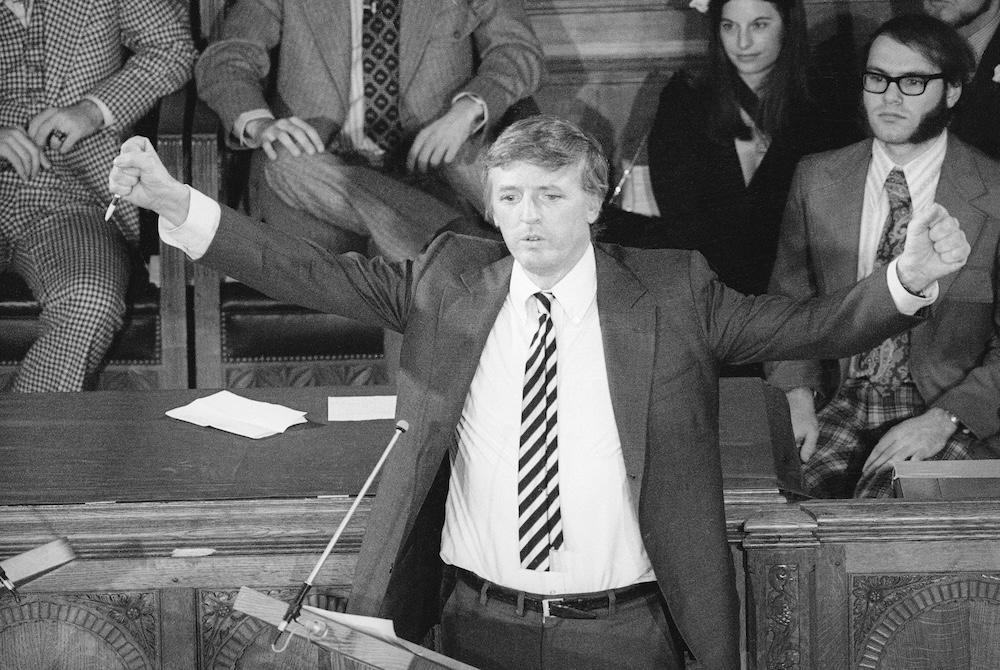
Sam Tanenhaus’s new biography of William F. Buckley Jr. is not just another book—it is an event. The National Review founder originally authorized Tanenhaus to write it in the 1990s, inspired by the strength of Tanenhaus’s biography of the anticommunist journalist Whittaker Chambers. Ever since, adherents of the conservative movement have been whispering about the project in a mix of eager anticipation and cautious trepidation. Now the biography, out just in time for the centenary of its subject’s birth, is well on its way to becoming one of the most–reviewed books of the year.
All the same, there is something rather untimely about the publication. After all, how much sway does Buckleyite conservatism still hold in American public affairs? While some remain loyal to the fusionist ideology WFB’s magazine long promoted, the populism and postliberalism that dominate right-wing politics today have little in common with it. In the pages of a Spring 2000 issue of Cigar Aficionado (of all places), Buckley himself dismissed Donald Trump as a “narcissist” and a “demagogue.” In some ways, Tanenhaus could not have written about a man more out of joint with our times.
But that is perhaps why America needs Buckley now more than ever. When he helmed National Review and was a fixture on PBS, young conservatives could look up to him and even emulate him. As a public intellectual, Buckley modeled the virtues of a gentlemanly comportment and an intellectual generosity that would be a great political tonic in this present age of rage and radicalism. Above all, we would do well to remember that Buckley was not a simple-minded reactionary motivated by self-interest or hatred, or even mere right-wing ideology, but rather a genuine patriot moved first and foremost by a conservatism of the heart.
Unfortunately, though, it is unlikely that Tanenhaus’s biography will bring that Buckley back to life. The author clearly admires certain things about the man, but he is very far from any kind of objective observer. Tanenhaus’s approach is ultimately too limited by his ideological commitment to liberalism; he is more interested in scrutinizing Buckley for his alleged sins against democratic orthodoxy than he is in providing a full assessment of a life well lived. All the same, Tanenhaus cannot conceal Buckley’s shining personality or inherent greatness.
The book excels the most in its depictions of Buckley’s childhood and early life, periods that have not been particularly well explored by other works on the man. Born to a wealthy Texan oil developer and a New Orleans nurse, he had a profoundly unusual upbringing. Buckley spent parts of his childhood abroad in Mexico, France, and England until returning to his family’s estate in Sharon, Connecticut. He learned Spanish and French before English, and gained his trademark transatlantic accent in his voyages across the ocean before the outbreak of World War II.
As comfortable as they were in elite circles, the Buckleys did not aspire to the WASPy trappings of their neighbors in the Northeast. As Tanenhaus puts it, at Great Elm and on their South Carolina estate, the family cultivated a “Catholic atmosphere” that was “fervent but also rarefied—opulent, sensual, aesthetic, and old.” They were not aping the English gentry so much as living like Spanish lords. The Buckley household was defined by a blend of cosmopolitanism and reactionary sentiment that left an indelible mark on the young Bill. Tanenhaus effectively and compellingly captures this atmosphere, and he deserves praise for the meticulous research that went into these sections of the book.
As a liberal, though, it seems that Tanenhaus simply cannot take Buckley’s conservative disposition very seriously. Although he frequently discusses Buckley’s faith, for example, Tanenhaus generally adopts a somewhat dismissive attitude toward it, as though his Roman Catholicism made him somehow alien. Indeed, by emphasizing the Buckleys’ family life, and especially the influence of William F. Buckley Sr., Tanenhaus seeks to link WFB Jr. to noxious strains of anti-Semitism and racism that defined the Old Right before World War II, and thereby delegitimize the new conservative movement he was so instrumental in founding in the 1950s. This problem is exacerbated by the total lack of balance in the book’s narrative; fewer than 50 pages of the 1,018-page-long tome address the years after the 1980 election, which proved to be intellectually pivotal for Buckley. Tanenhaus is far more focused on upholding liberal shibboleths and firing potshots to his right than he is in understanding his subject as he understood himself.
Beyond these obvious political biases, this error is also a consequence of Tanenhaus’s underestimation of Buckley’s intellectual merit. He is right to point out, of course, that Buckley never wrote a definitive work on conservative political thought, unlike friends such as Russell Kirk and his Conservative Mind and Whittaker Chambers and his memoir Witness. But in his role as a man of letters, Buckley engaged in a kind of public philosophic odyssey that was its own major contribution to the movement. He not only built institutions but also worked within them and through them to endow the movement with a sense of deep meaning and purpose.
Even more generally speaking, Tanenhaus’s engagement with the intellectual history of the conservative movement is quite shallow—and his account of Buckley’s life suffers for it. Take, for instance, his treatment (or lack thereof) of the Straussian political scientist Harry Jaffa. Especially after the Reagan presidency, Buckley frequently cited his work, most prominently his Abraham Lincoln scholarship, to help define American conservatism. And yet in Tanenhaus’s biography, Jaffa is mentioned only twice; on neither occasion does the author address his broader influence on the movement or on Buckley himself. Despite the heft of the tome, a casual reader unfamiliar with movement’s history or Buckley’s own writings could come away with entirely wrong impressions about how his views changed over time.
Probably the worst victim of Tanenhaus’s terrible simplifications, though, is Buckley’s friend Russell Kirk. The traditionalist thinker has long been willfully misinterpreted by critics on the right and left alike, and sadly this book is no exception. Tanenhaus cites the Michigander’s analysis of John C. Calhoun’s political thought to help build his case that the conservative movement is rooted in racist, neo-Confederate ideology. Of course, he makes no mention of Kirk’s glowing praise for Abraham Lincoln and the antislavery, pro-Union writer Orestes Brownson, and he completely misunderstands the critique of New Deal liberalism advanced by traditionalists such as Kirk and others in the National Review circle. Tanenhaus, it seems, does not particularly believe ideas have consequences.
It was precisely because he was an intellectual entrepreneur and man of letters, however, that Buckley himself often acknowledged the problems with extremism on the fringes of the conservative movement. Tanenhaus ably demonstrates, for instance, how Buckley led the purge of the John Birch Society and other unsavory elements in the 1960s. But because so much of the book is focused on the pre-Reagan years, he does not sufficiently address the way Buckley’s own views shifted on questions such as race and civil rights. The overall effect, then, is to give readers a strange, distorted perspective on the man, and even a sense that the book itself went to press only half finished.
If Buckley: The Life and the Revolution that Changed America is not about ideas or intellectual history, then what is it about? Rumor and gossip, in part. Tanenhaus spends an inordinate amount of time speculating about the sexuality of Buckley and members of National Review’s staff, for example, with far too little regard for these figures as actual human beings. Other aspects of the book suffer from too much broadness; giving readers a sense of a figure’s time and context is important, but Tanenhaus gets far too bogged down in the weeds. This biography would have been a better, more balanced book if it had focused more on the profound drama of the revolution in its subtitle than on the petty drama and historicizing grand narratives occupying too many pages.
Even so, it may perhaps seem unfair to ask Tanenhaus—who is, after all, more a journalist than an historian—to delve deeply into the lore of the conservative movement. But other authors have done a far better job of this, and in so doing have more adequately captured the mind and heart of William F. Buckley. Take, for instance, Matthew Continetti’s recent magisterial history of the movement, The Right. Buckley features as a main character in his narrative as well, but instead of the simplified political caricature Tanenhaus provides, Continetti actually takes him seriously as a thinker. Much of the thread he follows traces the ways Buckley’s own conservatism shifted away from the mix of European-style traditionalism and libertarianism that defined his youth. Over time, Continetti argues, he came to see himself first and foremost as a defender of the American Founding.
This journey, documented in countless columns and dozens of books, is what distinguished Buckley from the reactionary cranks of his own time and ours. He became an ardent constitutionalist first and foremost because he thought the framers’ settlement, ennobled by Lincoln, was the best suited to defend a traditional way of life. Really, Buckley’s philosophic odyssey can best be understood as a kind of love story—the more he fell in love with America, the more committed he became to conserving her regime.
One of Buckley’s most profound conclusions to this intellectual journey came in a 1990 book, Gratitude: Reflections on What We Owe to Our Country, which falls outside the true scope of Tanenhaus’s biography. Although on the surface a controversial call for national service, behind Buckley’s provocation is a piercing insight: Conservatism, rightly understood, is the chosen life of gratitude. “Materialistic democracy beckons every man to make himself a king,” he wrote, but “republican citizenship incites every man to be a knight.” Here, and in so many other places in his writings, Buckley was asserting what Edmund Burke called “the spirit of an exalted freedom.”
This is the conservatism of the heart that America so desperately needs today. Populist movements chasing after political power and the postliberal ideologues looking to justify that chase are, in the end, incapable of conserving much of anything at all. What made Buckley such an incredible organizer and advocate for conservative ideas is that he lived in such a way that invited people into his remarkable world. He was sophisticated and suave, to be sure, but never in a condescending or dismissive way.
Because he was not oriented toward power politics, Buckley came to be one of the most representative figures of the American Century. He could host figures as diverse as Allen Ginsberg and Ronald Reagan on his PBS program Firing Line—which cannot really be said of the increasingly siloed social media echo chambers now constituting the American right. Buckley was by no means a compromising squish or a partisan of mediocre mass culture, but he also wanted conservatism to be welcoming and truly representative. As a man of letters and a public intellectual, perhaps he can provide a model for navigating our fragmented culture and politics.
For all his book’s flaws, Tanenhaus nonetheless manages to capture something true about this loving spirit so inherent to Buckley’s character. For one, most of the book is quite well-written—a fact that would have no doubt pleased WFB, one of the finest prose stylists of the 20th century. Tanenhaus also admirably depicts Buckley’s overwhelming sense of adventure; reading the story of his life, even told in such an incomplete and occasionally frustrating way, is just plain fun.
No man is perfect, and William F. Buckley was no exception. Likewise, no biography is perfect, and Sam Tanenhaus’s book is certainly no exception. But as Publius put it in Federalist 85, “I never expect to see a perfect work from imperfect man.” One certainly hopes that other, more definitive books are written about this particular man and the movement he founded—but the publication of this biography and the occasion of this centenary serve, in the meantime, as reminders that we ought to be grateful for everything William F. Buckley Jr. gave to our movement, our culture, and our country.